



Why Software Governance Needs to Become a Leadership Discipline in the AI Era
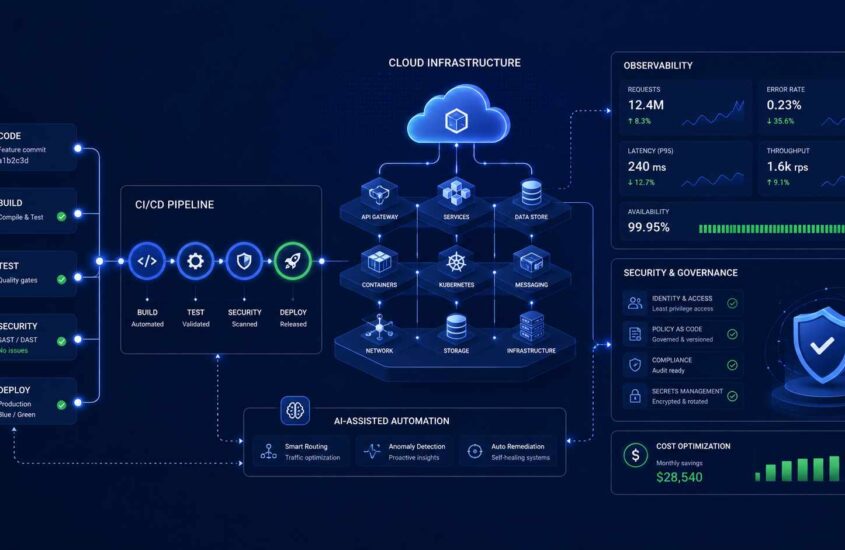
There is a familiar tension in many organisations: the business wants technology teams to move faster, while security, architecture, compliance, and operations teams are expected to keep risk under control.
For years, this has been treated as a delivery problem. If teams could just become more Agile, automate more testing, move to cloud platforms, or adopt better DevOps tooling, the thinking went, software delivery would improve.
Those things matter. But in the AI era, I think the deeper issue is leadership.
Modern software development is no longer just about how developers write and release code. It is about how an organisation makes decisions, manages uncertainty, governs risk, and learns from change. That makes software governance a strategic leadership discipline, not only a technical control function.
The main article on Modern Software Development in the AI Era: Why Speed Needs Governance explores this from an organisational perspective. The central point is simple: speed and governance should not be treated as opposing forces. The real challenge is designing governance so that teams can move faster with confidence.
This matters because AI changes the scale and pace of software work.
Generative AI can help teams produce code, test cases, documentation, scripts, and operational workflows more quickly. It can reduce repetitive effort and support better engineering productivity. But it can also amplify weak practices. If an organisation already has poor visibility, unclear ownership, inconsistent testing, weak architecture discipline, or fragmented security controls, AI will not magically fix those problems.
In some cases, it may accelerate them.
That is why leadership needs to move beyond the idea that AI adoption is mainly a tooling decision. Choosing the right AI coding assistant or automation platform is only one part of the conversation. The more important questions are:
- How do we know the software we are releasing is reliable?
- How do we ensure AI-assisted work meets our security and quality standards?
- How do we protect sensitive data?
- How do we help teams experiment safely?
- How do we avoid creating a culture where speed is rewarded but long-term maintainability is ignored?
These are leadership questions.
One lesson I have seen repeatedly is that modernisation fails when it is imposed without trust. Developers, IT teams, operations, cybersecurity, and business leaders all see the system from different angles. If governance is designed in isolation, it often feels like friction. If it is designed with the people doing the work, it can become an enabler.
This is especially important when introducing AI. People need to understand whether AI is being introduced to support them or to replace them. If the message is unclear, resistance is natural. If the purpose is framed around reducing repetitive work, improving quality, and helping teams focus on higher-value problems, the conversation becomes more constructive.
Good governance also requires humility from leadership. In a fast-changing environment, no organisation can predict every technology shift, security threat, or customer expectation. Future-proofing does not mean building a perfect system that never changes. It means building a culture and operating model that can adapt without chaos.
That requires a different kind of leadership posture.
Instead of asking only, “How can we deliver faster?”, leaders should also ask, “What needs to be true for faster delivery to remain safe, secure, observable, and useful?”
Instead of treating security as a late-stage review, leaders should ask how secure practices can be built into platforms, pipelines, and developer workflows.
Instead of using metrics only to pressure teams, leaders should use them to understand system health: deployment frequency, defect rates, incident recovery, customer satisfaction, security posture, and developer experience.
The organisations that succeed in the AI era will not simply be those with the most advanced tools. They will be the ones that create alignment between strategy, engineering, security, governance, and customer value.
That alignment starts at the leadership level.
Software has become too central to business performance to be managed as a back-office technical concern. AI makes this even clearer. The more powerful our tools become, the more important our operating principles become.
Governance should not be the brake on innovation. Done well, it becomes the steering system.







Follow me